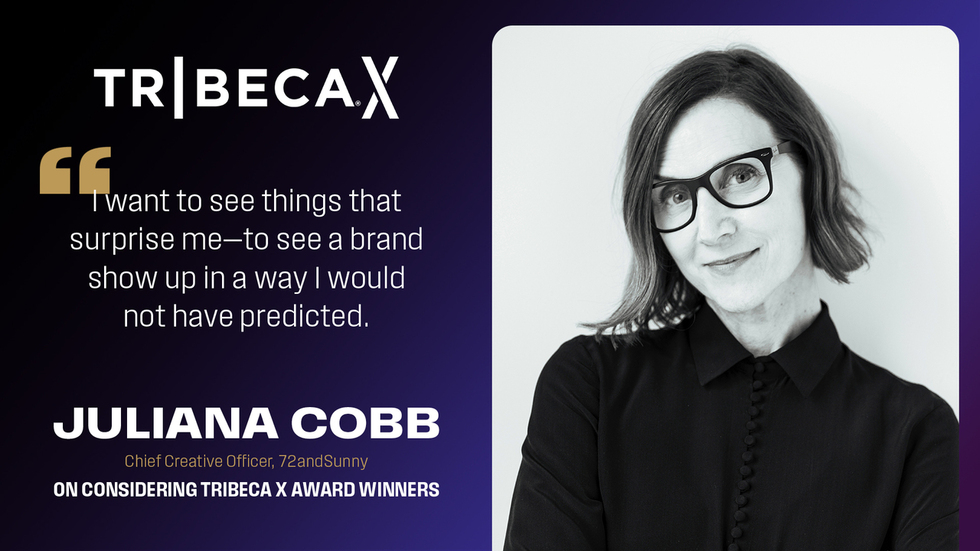
We sat down with 72andSunny Chief Creative Officer and Tribeca X Awards juror Juliana Cobb to talk about the business of brand storytelling: what’s resonating right now, what she’s watching, and what separates standout work at the Tribeca X Awards.
Submissions for the 2026 Tribeca X Awards are open. The Awards honor brand-supported storytelling that prioritizes narrative excellence and cultural resonance across formats—including film, episodic series, social content, commercials, and podcasts. Past winners include brands like Uber, Mejuri, and The Ordinary.
Submissions close April 8. Read the interview below—then make sure your work is in the mix.
The following interview has been condensed for clarity.
Tribeca X : Your work sits at the intersection of entertainment, brands, and storytelling. Can you tell our readers what that looks like day-to-day and why this moment feels especially exciting?
Cobb: People aren’t tuned in to “ads,” they’re tuned into culture. They don’t want to feel sold to, they want to be entertained. And especially these days, when their attention is divided and there are so many options at their fingertips, people don’t have the patience for a brand that doesn’t understand the assignment.
All of which makes this a really cool time for creative agencies, who get to steward brands through the process of creating stories that will genuinely connect with their audience – with authenticity and in the channels where they spend their time (spoiler: often, it’s not TV). The aperture has widened and there’s so much room to play since there are so many more ways to tell a story than ever before.
We’ve had a blast with our Panera clients, weaving their brand into cultural moments and fan truths on social. We tapped into the fever of The Summer I Turned Pretty , bringing in Chris Briney to resolve the dilemma of having to choose at all, thanks to Panera’s You Pick Two menu offering.
VIDEO
We tapped Bridgerton culture for our Google clients, showing how their AI-enhanced Google search and shopping tools can help any Bridgerton stan step into the world their own way. For Champion sportswear, we made an exhibit at the Brooklyn Museum celebrating iconic hoodie designs from Kith and B.A.P.E. while letting fans design their own.
We begin each assignment not with a deliverable, like a TV spot or a social post, but with a question: “What will make our audience care about this product or brand?” That shapes our storytelling and how we put the brand out into the world.
Having just been recognized as Ad Age’s Sports and Entertainment Agency of the Year, 72andSunny is known for moving at the speed of culture. My job is to ensure our storytelling isn't just "accurate" to the brand, but additive to the cultural conversation. If a brand isn't contributing something to the culture—humor, utility, or inspiration—it’s just noise.
Tribeca X : As a member of the Tribeca X Jury, what are you looking for in a good brand story? What do you wish you saw more of?
Cobb: In an era where AI can make anything, I’m looking for humanity and human truth. I love what AI can help us do, but it’s definitely making a lot of us respect the importance of the human mind, human empathy, and ingenuity as an irreplaceable key to telling stories that are meaningful and memorable. I want to see stories that make me feel something (a laugh or a tear or a spot of rage, just something), and which I want to talk about and share—stories that might even change me.
I want to see things that surprise me—to see a brand show up in a way I would not have predicted, and yet feels totally right for them—and which makes me appreciate that brand more because of it.
And I’m hopeful I’ll see some really interesting creator collaborations. Not just influencer shills, but interesting ideas where the brand trusted their fans enough to hand over the brand and let them play with it and interpret it and recast it into the world with their own spin. That’s how a brand lands its place in culture and catches on with new people.
Tribeca X : We’re seeing more films, series, and podcasts integrate brand partnerships earlier in the storytelling and marketing process. What are some recent examples that stood out to you as particularly effective or culturally resonant?
Cobb: The most effective partnerships today aren't just integrated, they’re foundational to the story itself. We’ve moved past the era of “product placement” into an era of “brand-as-producer,” where brands have more say over how, where, and when they show up in the story. What works is when a brand doesn't just pop up in a scene, but provides the cultural or narrative context that makes the scene possible. If a brand isn't contributing humor, utility, or inspiration to the viewer, it’s just noise.
I love Stranger Things as an example, because it’s such a masterclass in integrating brands like Coke, Eggo, and Casio not as ads, but as essential world-building tools. It taps our collective nostalgia. The brands aren't interrupting the 80s setting—they are the 80s setting. It feels authentic because the partnership starts at the script level, which ensures the brand's presence feels additive to the fan experience rather than an annoying distraction.
I even think A24’s Marty Supreme gave us some great examples of brand-as-storyline just looking at the role the Wheaties box played in that story. And then life imitated art when Wheaties actually made a custom Marty Supreme box . This is the dream—when life and culture take up the narrative and play it back in cool ways.
Tribeca X: How can storytellers and marketers push the envelope even further when it comes to collaboration between entertainment and advertising? What excites you most about where this work is headed?
Cobb: Most advertising agencies are already aiming to make work that feels more like entertainment and less like an ad just shilling at you at max volume. That will never change. It’s why we’ve had iconic pieces of advertising that informed culture through the years, from lexicon like “where’s the beef?” and “wassuhhh!!!” to the mind-blowing Super Bowl spots we all loved talking about the next day.
What’s different now is that our audiences are bombarded by media and are less tolerant of ad-like things, and at the same time we have more ways to connect with them more meaningfully.
Instead of an ad, make a billboard designed to set a Guinness World Record, like our recent NASCAR work from LA.
VIDEO
Instead of an ad, make a telenovela starring Melissa McCarthy , like our Amsterdam office recently did for e.l.f. cosmetics. Instead of an ad, make a purse with a hot foil pouch to keep a croissant toast sandwich warm, like we did for our Panera clients in our New York office. (They sold out three times and now you can find one on Poshmark for $150.)
Audiences’ skepticism isn’t a hardship—it’s a massive opportunity. There’s no room to be boring. It resets the bar, and brands know this—they’re getting more inventive and creative at showing up in places where their audiences spend time, in ways their audiences love.
That’s why social is such an interesting space, where brands can connect with people in a more intimate and less restrained or conventional way than a 30-second commercial might afford. It’s too easy to skip right over anything that doesn’t entertain and capture you right away. I love seeing brands that understand how to deliver entertaining content their intended audience will eat up.
Fashion brands are killing it here. Gone are the vapid parades of bodies draped in garments. Instead, consider Thierry Mugler , bringing a more inclusive and unexpected heroine in the form of David Hoyle’s drag persona to model the clothes with just the right amount of subversive to be totally captivating. Or Burberry, with their Olivia Colman and Barry Keoghan films that have taken the authentic truth of their brand—their Britishness—and channeled it into what feel like unscripted, raw, almost awkward little short films. We don’t feel sold to—we feel pulled into the story.
Tribeca X: To end on a fun note: did you have a favorite piece of content from the year? And a favorite brand campaign?
Cobb: My favorite piece of content was the Bad Bunny halftime show. It was such an exquisite middle finger to xenophobia in America, while also being a love letter to LatinX culture and the universality of being “American.” Chef’s kiss. No notes. And boy did we need that joyful bop!
Since this just came out, I have to give a shoutout to the continuation of the Adidas Superstars campaign with Samuel L. Jackson. Love the artfulness of the visual storytelling and the focus of the whole narrative being this quest for the shoes—the shoes are at the center of the story, while the story takes you all kinds of out-there places. Big fan of the music track, too.
Get your work in front of leaders like Juliana Cobb at the Tribeca X Awards this June. Submissions close April 8!